
Civil War Facts
Answers to your Civil War Questions
Léalo en Español »Many elements of Civil War scholarship are still hotly debated. The facts on this page are based on the soundest information available.
The war began when the Confederates bombarded Union soldiers at Fort Sumter, South Carolina on April 12, 1861. The war ended in Spring, 1865. Robert E. Lee surrendered the last major Confederate army to Ulysses S. Grant at Appomattox Courthouse on April 9, 1865. The last battle was fought at Palmito Ranch, Texas, on May 13, 1865. Click here for a Civil War timeline.
 The bombardment of Fort Sumter (Library of Congress)
Q. Where was the Civil War fought?
The Civil War was fought in thousands of different places,
from southern Pennsylvania to Texas; from New Mexico to the Florida
coast. The majority of the fighting took place in the states of
Virginia and Tennessee. The Civil War was also contested on the
Atlantic Ocean as far off as the coast of France, the Gulf of Mexico,
and the brown water of the Mississippi River and its tributaries.Battles of the Civil War | Civil War Navies
Q. How many soldiers fought in the Civil War?
At the beginning of the war the Northern states had a combined
population of 22 million people. The Southern states had a combined
population of about 9 million. This disparity was reflected in the size
of the armies in the field. The Union forces outnumbered the
Confederates roughly two to one.
Q. How many soldiers died in the Civil War?
Approximately 620,000 soldiers died
from combat, accident, starvation, and disease during the Civil War.
This number comes from an 1889 study of the war performed by William F.
Fox and Thomas Leonard Livermore. Both men fought for the Union. Their
estimate is derived from an exhaustive study of the combat and casualty
records generated by the armies over five years of fighting. A recent study puts the number of dead as high as 850,000.
Q. How many soldiers died in the Civil War as compared to other American wars?
Roughly 1,264,000 American soldiers have died in the nation's
wars--620,000 in the Civil War and 644,000 in all other conflicts. It
was only as recently as the Vietnam War that the amount of American
deaths in foreign wars eclipsed the number who died in the Civil War.
Q. Who won the Civil War?
The Northern armies were victorious, and the rebellious states returned to the Union.
Q. Who ran in the election of 1860?
The election of 1860 was one of the most unusual in American history.
In a four-way race brought on by a split in the Democratic Party, Abraham Lincoln's name did not even appear on the ballot in most Southern states. In the electoral college,
Lincoln solidly carried the free states of the Northeast and
Northwest. Breckenridge won the slaveholding states, with the exception
of Tennessee, Virginia and Kentucky in the Upper South, which went to
Bell. Douglas, though he made a solid showing in the popular vote, only
took electoral votes from Missouri and New Jersey.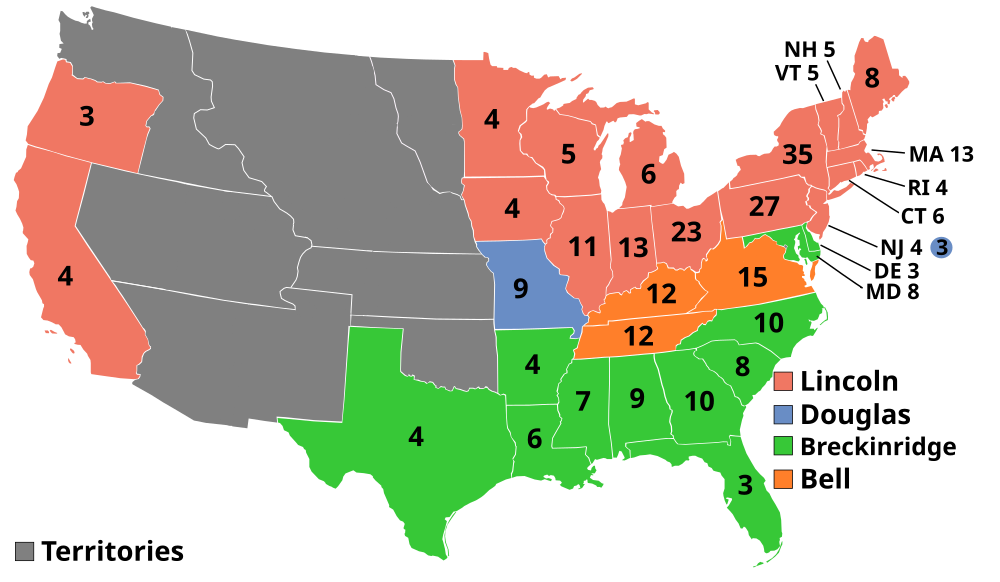
 Abraham Lincoln delivers his first inaugural address on March 4, 1861. (Library of Congress)
Stephen A. Douglas of Illinois, Northern Democratic Party: 29.5%
John C. Breckenridge of Kentucky, Southern Democratic Party: 18.1%
John Bell of Tennessee, Constitutional Union Party: 12.6%
Q. When did the Southern states secede from the Union?
- South Carolina - December 20, 1860
- Mississippi - January 9, 1861
- Florida - January 10, 1861
- Alabama - January 11, 1861
- Georgia - January 19, 1861
- Louisiana - January 26, 1861
- Texas - February 1, 1861
- Virginia - April 17, 1861
- Arkansas - May 6, 1861
- North Carolina - May 20, 1861
- Tennessee - June 8, 1861
Q. Was secession legal?
No, although it was not ruled illegal until after the war. This was a
complex question at the time, with able legal minds to be found arguing
both sides, but the United States Supreme Court, in Texas v. White,
74 U.S. 700 (1868), determined that secession was unconstitutional.
Chief Justice Salmon Chase wrote in his majority opinion that, "The
ordinance of secession...and all the acts of legislature intended to
give effect to that ordinance, were absolutely null. They were utterly
without operation in law."
Q. What caused the Civil War?
While many still debate the ultimate causes of the Civil War,
Pulitzer Prize-winning author James McPherson writes that, "The Civil
War started because of uncompromising differences between the free and
slave states over the power of the national government to prohibit
slavery in the territories that had not yet become states. When Abraham
Lincoln won election in 1860 as the first Republican president on a
platform pledging to keep slavery out of the territories, seven slave
states in the deep South seceded and formed a new nation, the
Confederate States of America. The incoming Lincoln administration and
most of the Northern people refused to recognize the legitimacy of
secession. They feared that it would discredit democracy and create a
fatal precedent that would eventually fragment the no-longer United
States into several small, squabbling countries."Trigger Events of the Civil War

- Gettysburg--51,000 casualties
- Chickamauga--34,624 casualties
- Spotsylvania--30,000 casualties
- The Wilderness--29,800 casualties
- Chancellorsville--24,000 casualties
- Shiloh--23,746 casualties
- Stones River--23,515 casualties
- Antietam--22,717 casualties
- Second Manassas--22,180 casualties
- Vicksburg--19,233 casualties
Too often, people take 'casualty' and 'fatality' to be interchangeable terms. In fact, a casualty is "a military person lost through death, wounds, injury, sickness, internment, or capture or through being missing in action." Essentially, a casualty is any soldier who goes into a fight and does not return fit to take part in the next battle. Many soldiers, especially in the Confederate ranks, became casualties several times: some soldiers were captured multiple times; some were wounded in non-consecutive engagements.
Q. What caused casualties during a battle?

Q. What happened to the dead?
Typically, soldiers were buried where they fell on the battlefield.
Others were buried near the hospitals where they died. At most
battlefields the dead were exhumed and moved to National or Confederate
cemeteries, but because there were so many bodies, and because of the
time and effort it took to disinter them, there are undoubtedly
thousands if not tens of thousands of Civil War soldiers in unknown
battlefield graves.
Go In Depth
Historian Pete Carmichael
describes the process of finding, burying, and reburying the dead after
battles. He also discusses the significance of having a "decent
burial," and efforts to lay soldiers to rest in military cemeteries in
the years after the war. This video is part of the Civil War Trust's In4 video series, which presents short videos on basic Civil War topics.
Q. What happened to prisoners?
More than 400,000 soldiers were captured over the course of the Civil
War. In the first years of the conflict, equal numbers of captured
troops were regularly exchanged for one another, helping to keep the
total number of prisoners manageable for both sides. Over the course of
the war, however, that practice faded from use. By the end of the war,
the plight of prisoners of war on both sides had become bleak indeed.
Thousands of Southerners died in the freezing camp at Elmira, New York,
and the camp at Andersonville, Georgia, which held Union prisoners, has
become one of the most infamous in the history of war. Nearly as many
men died in captivity during the Civil War as died fighting in Vietnam.
Q. How advanced was medicine during the Civil War?
Two thirds of those killed in the Civil War died of disease. Germ
theory had not been widely accepted in the medical world at the time of
the Civil War and modern antiseptics, which could have greatly reduced
the spread of bacteria and the outbreak of disease, did not exist. As
George Worthington Adams famously wrote, “The Civil War was fought in
the very last years of the medical middle ages.” Chloroform, ether and
whiskey were the main anesthetics. Still, many survived their wounds and
had only the dedicated doctors and nurses and their selfless efforts to
thank. Medicine is an ever-evolving science. Unfortunately for those
who fought in the Civil War, the technology of warfare had surpassed the technology of health care. A Union field hospital at Savage Station, Virginia in 1862. (Library of Congress)
Q. How was the army organized?
 The largest military unit is the army, which is sub-divided into smaller
commands. Although organization varied between the armies, the largest
sub-section of a given army was the corps, which was typically divided
into two or more divisions, each composed of two or more brigades, which
were each made up of two or more regiments, with each regiment
containing roughly ten companies of ideally 100 men (but more typically
near 30). Companies themselves were subdivided into platoons and squads
before the army finally reached the level of the individual soldier.
Armies were sometimes grouped together in "departments" that were
defined by geography and operational objective.
The largest military unit is the army, which is sub-divided into smaller
commands. Although organization varied between the armies, the largest
sub-section of a given army was the corps, which was typically divided
into two or more divisions, each composed of two or more brigades, which
were each made up of two or more regiments, with each regiment
containing roughly ten companies of ideally 100 men (but more typically
near 30). Companies themselves were subdivided into platoons and squads
before the army finally reached the level of the individual soldier.
Armies were sometimes grouped together in "departments" that were
defined by geography and operational objective.

Go In Depth
Historian Garry Adelman explains how the Union and Confederate armies organized and led their infantry, cavalry, and artillery units. This video is part of the Civil War Trust's In4 video series, which presents short videos on basic Civil War topics.
Q. How much were soldiers paid?
A white Union private made thirteen dollars a month;
his black counterpart made seven dollars until Congress rectified the
discrepancy in 1864. A Confederate private ostensibly made eleven
dollars a month, but often went long stretches with no pay at all.
Q. What role did African-Americans play in the war effort?
With the issuance of the Emancipation Proclamation in September 1862, African-Americans - both free and runaway slaves - came forward to volunteer for the Union cause in substantial numbers. Beginning in October, approximately 180,000 African-Americans, comprising 163 units, served in the U.S. Army, and 18,000 in the Navy. That month, the 1st Kansas Colored Volunteers repulsed a Confederate attack at Island Mound, Missouri. Men of the U.S.C.T. (United States Colored Troops) units went on to distinguish themselves on battlefields east and west - at Port Hudson, Louisiana; Honey Springs, Oklahoma; Fort Wagner, South Carolina; New Market Heights, Virginia. African Americans constituted 10% of the entire Union Army by the end of the war, and nearly 40,000 died over the course of the war.

Go In Depth
Historian Hari Jones
summarizes the experience of African American Civil War soldiers, from
emancipation to the authorization of United States Colored Troops to
their experiences on the battlefield. This video is part of the Civil War Trust's In4 video series, which presents short videos on basic Civil War topics.
Q. What did soldiers do in their free time?
When they were not drilling, which made up a considerable portion of their time in camp, soldiers passed the time writing letters, playing games like checkers, dominoes and poker, drinking, smoking, whittling, making music and praying. One soldier summed it up when he wrote to his wife, "Soldiering is 99% boredom and 1% sheer terror."
Civil War Winter Encampments
Q. What did soldiers eat?
 A Union soldier poses in front of a "fresh" shipment of hardtack. (Library of Congress)
Civil War soldiers' fare varied substantially from army to army and throughout the course of the war for both sides. For the most part, neither side ate particularly well. Hardtack and coffee were the staples, in addition to salt pork, corn meal and whatever fruits, vegetables and berries could be collected on the march. Many Confederate soldiers were in a state of near-starvation by the war's end.
Q. What was the average soldier's age?
The average Union soldier was 25.8 years old; there is no definite information on the average age of Confederate soldiers, but by the end of the war old men and young boys, who otherwise would have stayed home, were being pressed into service. The average soldier on both sides was a white, native-born, protestant farmer.
Q. Did anybody win the Medal of Honor in the Civil War?
Yes. There were 1522 Medals of Honor issued to Northern troops, black and white, over the course of the war. The Confederate Army did not have combat medals. Robert E. Lee explained that the highest honor possible was to be "mentioned in dispatches," in other words, to be included in an officer's report for particularly gallant conduct. John Singleton Mosby, the "Grey Ghost," was mentioned in dispatches more than any other Confederate soldier.
Q. Were there naval battles in the Civil War?
Yes, the North and South waged war on the Atlantic Ocean, in the Gulf of Mexico, and in the rivers of the mainland. Cotton trade with Europe was vital to the Southern war effort, which led Union General-in-Chief Winfield Scott to order a strangling blockade known as the "Anaconda Plan." While Southern blockade runners tested this screen, engineers were inventing the first ironclad warships the world had ever seen. On the rivers, gunboats, shore batteries, and island fortresses entered the battle as both sides fought for control of inland arteries that were essential to the fast transport of men and material. The Civil War at sea, mostly notably with the development of the ironclads, changed the trajectory of naval warfare around the globe.
Civil War Navies
 The duel of the ironclads U.S.S. Monitor and the C.S.S. Virginia drew international attention. (Library of Congress)
Q. What was the range of Civil War artillery?
Smoothbore cannons, such as the 12-pounder Napoleon, had a range of around three-quarters of a mile; rifled cannons, such as the 10-pounder Parrott, had a range of one and a half miles, or about double that of a smoothbore. Some larger cannons and imported pieces could fire even farther.

Go In Depth
Historian Garry Adelman describes the different types of Civil War cannons and ammunition, and explains how they were fired. This video is part of the Civil War Trust's In4 video series, which presents short videos on basic Civil War topics.
Q. How did the draft work?
The Confederacy instituted the first draft in American history in
April of 1862. It was clear that the South, with a total population of 9
million (including 4 million slaves), would have to muster all of its
manpower to repel the North, which had an 1860 population of around 22
million. The Confederate draft exempted those who owned twenty slaves or
more, however, arousing resentment amongst the poor whites who
constituted the vast majority of the army. Abraham Lincoln instituted a
draft on the Northern states a year later, likewise calling on all
able-bodied 18-35 year old men to serve. There were exemptions in the
North, too, if those drafted could pay a significant fee or provide a
substitute.
Q. Why are there alternate names for Civil War battles?
Union commanders typically named battles after the nearest river or
creek. Confederates typically named battles after the nearest city or
town. But these rules did not always apply; they were highly dependent
on the names employed by the victors, the public and the media. This view shows Union ironclads firing heavy ordnance near Charleston Harbor. (Library of Congress)
Photography was a new art form when the Civil War broke out. The cameras and chemicals available at the time were too unwieldy and unstable to accommodate the chaos of a battlefield. Nevertheless, a few photographs of Civil War combat do exist, including images of artillery bombardments, gunboat broadsides, and battle smoke at Nashville and Fredericksburg. Thousands of other Civil War photographs can be found online at the Library of Congress.
Q. Were there black Confederate soldiers?
Slaves and free blacks were present in the Confederate lines as handservants and manual laborers. On March 14, 1865 the Confederate military issued General Orders No. 14, which provided for the raising of black combat regiments, but there is no official military documentation that indicates these orders were carried out or that any black soldiers were ever properly enlisted in the Confederate army. There are a few photographs of blacks in Confederate uniforms, but these appear to be hoaxes.
Q. What are some of the best Civil War books?
Battle Cry of Freedom by James McPherson -- Considered by many to be the finest single-volume history of the Civil War era.
A Stillness at Appomattox by Bruce Catton -- The third and final volume of Catton's critically-acclaimed Civil War trilogy; winner of the Pulitzer Prize.
The Civil War: A Narrative by Shelby Foote -- Three volumes, three thousand pages and more than a million words.
The Killer Angels by Michael Shaara -- The best Civil War novel of the 20th century and the inspiration behind Ken Burns' epic documentary.
Company Aytch by Sam Watkins -- An illuminating Confederate memoir by a Tennessean who fought practically everywhere in the Western theater
The Civil War Trust's comprehensive bookstore can be found here.
Q. How much battlefield land has the Civil War Trust saved?
More than 34,000 acres and counting!
0 comments:
Post a Comment